I get my flu shot every year, religiously. I have a hundred students every semester, give or take; most of them live in dorms, where disease travels as easily as a leaf down a stream. As such, I consider myself at elevated risk for flu—not as much at risk as, say, a pediatrician, but certainly more than most people’s jobs give them. I wash my hands between classes and keep tissues and hand sanitizer in my office. Most assignments in my classes are done online, not by paper. This is to say that I take reasonable, recommended precautions against flu. And in general, it’s worked.
While I had intended to spend my spring break sewing my wedding dress, maybe with some nice before and after pictures here if I made enough progress, I spent it in bed. With the flu.
It wasn’t my students who gave it to me. It was my partner, who picked it up at his workplace. Patient 0 there seems to have been one of the management, probably a case of presenteeism. I had insisted this year that my partner get a flu shot when they offered it at the normal time. He still brought flu home. My partner grumbled something about “The one year I get a flu shot, I get flu.”
I want to adamantly say that that’s not what happened here. I want to defend my flu shot’s efficacy, and I want to encourage, given the current fears about coronavirus (which transmits by the same mechanisms and in many biological ways is similar to flu), that everyone else get flu shots as they’re able.
My symptoms were mild. If it weren’t for a few key differences—sudden onset, high fever, lack of sore throat (which I usually get with a cold), body aches—I’d have assumed I simply had a cold. And I got over it quickly. Many of my partner’s coworkers were not so fortunate, as I understand several of them went to the doctor for their symptoms. That’s how I know for near certain it was one of the flu type A strains, because that’s what they tested for.
The annual flu shot works best against Type B strains, which mutates more slowly and is often more severe. So that’s also a good indicator that my shot worked as expected. Type A just is a little more flexible than the vaccine can fully account for.
But the other thing is that the flu shot can actually make it so that if you do get sick, as I did, your symptoms and duration will be less severe, as it was.
So I don’t want anyone to take my case as an example in why not to get a flu shot. My case is a textbook example of why exactly you should get your flu shot.
And, bear in mind that the CDC and the WHO are recommending that, in the face of novel coronavirus, which we don’t yet have a vaccine for (they’re working on it!), people should stay up to date on their vaccinations, especially flu. It won’t stop you from getting Corvid-19, but it will help keep you from having to go to the hospital with flu complications.
I never had to report to a clinic or even ask for help with my symptoms. I didn’t even realize it was flu until I was nearly well again. My fever stayed manageable with at-home care, as did my other symptoms. It was a best case scenario (short of the actual best case, which is not to get sick at all). And for that, I’m thankful to my flu shot, which I got in the fall. It didn’t completely prevent me getting sick, but it sure did relieve the burden of getting sick to the level of a bad cold rather than serious flu symptoms. That was one less office visit at the local healthcare facilities, a visit that can be used for someone who has underlying conditions or other risk factors, or (heaven forbid) someone with the novel coronavirus.
So what I’m saying is that I would like for everyone to follow the official recommendations right now: Get your vaccinations.
I’ve got another item from my Facebook archives today (this one’s from February 21, 2014):
So I’ve been wondering what the effect of superhero presences would be on crime rate in a given area. Generally, superheroes deal with a few select high profile crimes–those committed by supervillains. Because of narrative selection, we tend to see mostly superhero successes (and a few select dramatic failures).
But we know that there IS still crime in these superhero spaces; we occasionally see superheroes foiling a common crime, such as a mugging (cf. the origin stories of Batman and Spiderman, for instance), but this generally only happens when the superhero just happens to be on hand at the time. We also know that there must be enough crime to require a reasonably sized police force, as we often see police in action in the backgrounds of superhero stories.
The best Batman (Adam West) works closely with traditional law enforcement Via GIPHY
I see this going three ways: The presence of superheroes can increase or decrease local crime rates, or it may have no overall effect.
Decrease: Criminals and criminal organizations are aware that superhero intervention is a threat, and are therefore more cautious, causing a polarizing effect in which you only get two kinds of criminals: dumb ones who aren’t considering the consequences of their actions and tend to act more impulsively, and the ones who think they’re clever enough to outsmart the superheroes for whatever reason. Cops on the street wind up mostly acting as support for the superheroes and function to keep down the dumb ones, which should be pretty light work.
Increase: The presence of superheroes attracts supervillains. This is demonstrably true. It is possible that the presence of supervillains encourages crime, both actively in which they recruit petty criminals to do work for them (we see this in some villain schemes, getting resources through petty crime, etc) and passively by serving as a role model–criminals aspire to supervillainy and start small.
No effect: Superheroes and supervillains cancel each other out, and ordinary crime continues as it would otherwise. In this case, we see a completely stratified crime system. Ordinary crime fighters (cops) fight ordinary criminals, and extraordinary crime fighters (superheroes) fight extraordinary criminals (supervillains), and they meet about as often as the very rich and the very poor do in a given city; they pass each other in the street and sometimes intervene, but generally keep to themselves. There is some evidence for this theory in that we see as plot elements that people are often driven to crime in superhero universes by ordinary adverse circumstances (they can’t pay the rent, they need money for medical treatment, etc), so we know that ordinary crime still exists in superhero-infested places.
I have not accounted for white-collar crime (embezzling, bribery, insider trading, and other forms of corruption) in this discussion, but that’s certainly something worth considering.
The next question, of course, is what effect the presence of superheroes has on ordinary law-enforcement organizations. [That’s a discussion for another time.]
Before the semester began, I wrote about my resolution to improve response times on student work by assigning due weeks and having students sign up for their due dates within the weeks, rather than having a set due date for the entire class. Last week I wrote about building revision into the syllabus, which was part of this experiment. I am now finishing up the second volley of assignments under this policy, so I’m able to draw a few conclusions and observations about it.
Overall, I think the policy is a success, and I’ll be happy to implement it again. It’s had some unexpected results, and for the most part, the gains from these unexpected results make the policy well worth its disadvantages.
As a reminder, the policy consists of two things:
Students choose their due dates within a range of a week, but only a limited number of students may register for any given day in that week.
Students may submit a revision with a short reflection within a week of receiving feedback, and the grade on the revision entirely replaces the grade on the original assignment.
To review, here is the verbatim policy as written into the syllabus:
Due Dates Reading quizzes will be due at a certain time, and grade automatically. You may, however, take reading quizzes at your convenience, and you may retake them. For all major assignments, you will select a due date during the “due week”. This will be done via a Google Doc link. Up to five students may select each day during the week; this will be done on a first-come, first-serve basis. Because of the self-selected nature of due dates in this course, late work will not be accepted. I reserve the right to make exceptions at my discretion. Revision Policy You may revise any major assignment that earns less a B or lower in order to have the revised version regraded. To revise, you must notify Dr. Cox in writing of your intention to revise and submit your revised assignment along with a short (1 page, double spaced) reflection on what choices you made in the revision process and why. This must all be submitted within 1 week of receiving your original assignment feedback and grade, unless you make alternate arrangements with Dr. Cox. Dr. Cox will then re-grade the revised assignment, and the new grade will replace the original assignment’s grade.
This is really two policies, but I’m finding that they really have to go hand in hand. If they don’t, then the students at the beginning of the week lose the advantage they get by signing up early. And, as I shall explain here, the policy has the unexpected effect of making students more eager for second chances, apparently.
So here’s a quick pro/con list of what this policy seems to have done to my classes:
Negative Effects
Positive Effects
-Exhausting for instructor -Competition for later due dates among students -Challenges in planning class activities during the due week
-Students are more proactive about their schedules -More office hours visits/drafts submitted for ungraded feedback -Faster feedback from the student perspective -More active, deep revisions in response to feedback -Built in plagiarism solution -Smaller grading piles, more distributed work load
Table of positive and negative effects of the policies on class
Let’s talk about the first thing I noticed with this policy: I am seeing my students more in my emails or office hours. I honestly didn’t expect this result. I am not at all sure why this is even happening. But this point encompasses a number of things on the table, both good and bad: more contact with students is, as far as achieving quality instruction, a very good thing. It’s also an exhausting thing, so it takes some getting used to. Students are sending me drafts before their due dates more than they ever did before, even though my ungraded feedback policy hasn’t changed at all. Students are dropping in on my office hours more often. Students are asking questions about their grades more–and instead of simply “Why did I get this grade?” it’s become “How do I do the revision?” and I think that’s definitely a win, because while the grade is still the extrinsic motivation, they’re able to do something productive about it that reinforces the pedagogical goals of the course (to learn about writing processes, get better at specific writing skills, etc). This creates more work for me, of course: I am spending more time working with students outside of class, and for many students I’m grading their assignments twice each. But it’s good praxis, really. Students are actively engaged in their writing processes, and recruiting me as an ally in the process, instead of as an adversary to be outsmarted.
In general, at least. I have to admit that there are still some problems coming up that you might expect. I’ve already had to deal with at least one plagiarism case. Of course, I can’t and won’t speak to the specifics of the case here, but I will say that I learned something else unexpected and wonderful about this set of policies in the process: they work excellently as a resolution to academic integrity violations. Mine is a course that teaches students how to do research and handle sources ethically; because of that, I don’t see academic integrity violations as something to be punished, but rather as failures in my own teaching to guide the student sufficiently before they get into a bad situation. Institutional policies can do as they please, but in a course where the goal is to teach students who may not have had to do extensive research before how to handle sources, a punitive approach is simply cruel, punishing students for violating rules they may not have even known they had to follow, much less have understood the finer points of.
However, the revision policy turns out to be a perfect remedy; under this policy, the student can still experience failing the assignment for a violation—a natural and common consequence—but can also not only revise the assignment properly and redeem the grade entirely, but gets a chance to reflect and report on their own choices in the process. This revision policy is the equivalent of having an extra life in a video game; you fail at the task, but you get to try again from right before where you failed, now armed with the knowledge of why you failed before and how to avoid it. Yes, it will still feel very bad, and, yes, forms still need to be filed for any truly serious infraction because rules are rules, but inside the class it’s a safe place to fail, and if you are at an institution that will uphold your own penalties in most cases, it works well. (if you are at an institution with a uniform policy on academic ethics violations, you are in a somewhat different situation and don’t have the same latitude to be gracious)
In addition to the benefits in a more process-focused mindset for students, there is something to be said for the way that the grading queue is somewhat more managed under this policy. It is not the fantasy I had imaged of clearing the grading queue before bed each night; it still builds up. But at no point, even with over a hundred students total (that’s including the extra 3-week seminars I’ve got this semester) has the “to do” number on Canvas hit the dreaded “99+” point where progress seems impossible. However, I have to admit that this hasn’t been quite the peace of mind I expected. The problem is that I’m working on bringing down the number while my students are working to bring it up, and there’s more of them than there are of me. It’s effectively trying to bail out a sinking ship with a leaky bucket, at least during the due week. You can have a great grading session, read through 10 or more papers, only to find when you come out of the SpeedGrader your queue has, in fact, gotten bigger than it was when you started. This is a bit disheartening, and I’ve found I have to make a separate tally of what’s in the queue before I start a grading session in order to prove to myself that I actually did something against the rising tide of papers. A small portable dry erase board has proved to be a life saver on that account.
Meticulous to-do lists are necessary to feel like you’re making progress; the grading pile won’t do it for you. Image by Suzy Hazelwood via StockSnap
Another unexpected consequence (that I really should have been able to see coming) of the due week policy was that lesson planning for class meetings during the due week is really challenging. I’ve found myself having to plan parallel lessons for half the class, giving students who have earlier due dates one set of activities in class and people with later due dates another set. This is not necessarily a bad thing; just a challenging thing.
But returning to the revision aspect of the policy, while on the topic of things I didn’t expect but should have seen coming, I am finding my students are more actively gaming the policies. This isn’t a bad thing, really—I want students thinking strategically and tactically about their work (that’s part of mastering rhetorical situations!). What I mean here is this: I’ve had a number of students knowingly submit poor, unready work—to the point of even leaving notes to me embedded in the work asking for guidance because they weren’t sure how to finish it—with the express and entirely transparent intention of taking advantage of the revision policy as a way to get a de facto extension on their work.
I don’t mind this at all, actually. As I said, it’s encouraging them to pay attention to feedback and engage in revision in ways I’ve never seen in a FYC classroom before. And I’ve found that I’m taking a similar approach to these due dates, encouraging students to submit and resubmit strategically when they seem stuck.
Moreover, I found that I’m not being particularly worried about late work either. Although as written the policy forbids all late work, in practice I’ve found I just don’t care, and I’m granting forgiveness for late work left and right. As long as not everyone is submitting on Friday all at once, what difference does it make if one or two students need an extension by a day or two? I think if I use the policy again (and I likely will) I’ll revise it to more precisely say that late work is only at the instructor’s discretion, rather than saying that it won’t be accepted.
Finally, I want to speak to the goal of the policy: improving feedback times. Regarding this, I think it actually is working. It hasn’t made my experience of grading sessions much different–it’s still 2-3 weeks of work for me to get through all four sections of my FYC courses every time they have a major assignment. However, from the students’ perspective, the grading times have significantly reduced. For the first paper, no student waited more than two weeks for their feedback; that wasn’t great, I admit, but better than some semesters when the depression or other things have hit and students waited as much as a month. For the second round of assignments, which I’m just finishing up now, I was better prepared for what this policy would do for me, and so no student will have waited more than a week for feedback. That’s a big deal.
I can’t understate how important that is. Sure, I’m exhausted by by the work load (aren’t we all?), and from my view it hasn’t been much different. But I know for a fact it’s different from the students’ viewpoints. In previous semesters, I’ve been worn down with students asking “So, um, when will our papers be graded?” But this semester, I overheard a student saying to another before class “She’s really fast at grading!” “No, I’m not,” I answered, recalling my previous semesters’ student evaluations, which all scored low for timely feedback. But no sooner had my protest escaped my lips than I realized: from their perspective, I was. Not because I’m suddenly better at grading (I’m not), but because I’d given the students more control over their own deadlines.
Thursday last week was like one of those episodes in a sitcom where there’s multiple plots going on, and the most interesting plot is put in the background, so that the main characters only sometimes see glimpses of what’s happening.
That’s me. I’m the main character. And I have no idea what was happening in the more interesting plot. In fact, I’m giving you these sparse details as a writing prompt. Please write this story for me. I want to see what you come up with!
My fiance and I had scheduled to meet someone at a local cafe downtown. The person we were supposed to meet wound up not showing up for a reasonable cause that we didn’t know about. So we waited, watching people to see if that person showed up, for nearly an hour while we enjoyed our warm tea on a cold day with the lightest flecks of snow in the air.
At one point, a man dressed in black pants and a black leather jacket, with a pastel pink backpack strapped securely on his back, came into the cafe. He had an angry, bitter look on his face and didn’t greet anyone or turn his gaze to either side, looking only straight ahead in the direct he was power walking in a hurry. He walked past the cafe counter and went straight to the back and pushed through the door to the hallway where the bathrooms were, even though the sign clearly said that the bathroom was for customers only.
This alone, was not particularly notable, of course. Maybe he needed to pee really bad before he ordered a drink.
Some minutes later, he pushed out of the bathroom space again. He was in the same foul mood, walking in a hurry and looking at no one. As he passed by where we were watching, I saw he had his hand down at his side, pressed against his thigh and slightly behind him. In his hand was a knife—a blade of about four or five inches—sheathed in leather. He was holding it with the blade shielded slightly along his wrist, keeping his hand low and behind him, the way one does when one doesn’t want what they’re carrying to be seen.
He stormed out of the cafe with the same alacrity that he had entered, still not even acknowledging the staff. When he had gone, I turned to my fiance: “Um, I think someone might have just been murdered,” I half joked. “He had a knife.”
Slightly alarmed, when I described the knife, my fiance bravely went into the bathroom to make sure that no one had, indeed, been murdered. After all, if someone was injured, they’d need help. But there was no blood on the knife or the man, and there was no body in the bathroom. So, honestly, it was probably nothing. I don’t know what he was doing but he might have had perfectly legitimate business, and nothing seemed suspicious enough to alert anyone.
We waited some more time, and then we decided to go elsewhere. As we were leaving the cafe by the best way to do so, we saw the man again: now he was riding on a bike, going quickly by perpendicular to the road we were on, and his pink backpack was now clutched in his arms, tight against his chest. The direction he was riding was from another part of downtown; he’d obviously gone somewhere else in the meantime. What confused me most was that he was holding the backpack: it’s easier to ride with a backpack when you’re wearing it on your back, as he had originally been, not with it in your arm and pressed against your chest as he was doing here.
And that’s where my knowledge of his story ends. Except…
About 20 minutes later, and probably entirely unrelated, we passed by the courthouse. There was another man (as far as I know) waiting on the curb by the courthouse wearing a balaclava. Sure, it was a cold day–it might have just been to be warm. Again, nothing terribly suspicious or worth acting on.
But, reader, I really want you to come up with a story that involves both these characters, whom we are affectionately calling Knife Guy and Mask Guy. What kind of heist are they up to? Are they allies? Are they rivals? You decide!
Bonus: A colleague posted a photo they took of a man leaping between the tops of train cars on the same day. Might we have a third character in our action flick—Train Guy?
Muriel Harris usefully posited the notion of “one-draft writers” and “multi-draft writers” in 1989. For anything less than a novel, I tend to be a “one-drafter”, meaning that I resist revision because I do most of my deep revision on the planning end of things. My outlines are basically my first drafts, and by the time I have something that looks remotely like my final goal, I’m pretty much done.
Not everyone writes this way; there are “multi-drafters” who are throwing things onto the page and then teasing out what’s worth keeping. I liken the difference to a sculptor who works in clay (one-draft) who builds up and then occasionally cuts away versus a sculptor who works in stone, who makes big cuts and then makes fine cuts, but ultimately spends all their time removing what isn’t working. It’s not a perfect metaphor, but it works for me.
The problem is that the classroom models of teaching seldom allow both kinds of processes. Too often we say multi-drafting is best, where deep revision should happen after a first draft, but we also model and enforce one-drafting, where we require outlines and timed-writing situations, which privilege one-drafting. Assignments are often one-and-done draft situations. After all, we have too many students and not enough time to read the same paper over and over, right?
I’ve experimented with a revision policy before to try to reconcile this disconnect between what we say and what we do in the classroom, and to support multi-drafters in the classroom, but no one really took it. This semester, though, my revision policy has been actually working–several students are taking advantage of it and they are truly making deep revisions in light of the feedback they’ve gotten on their graded work.
So what’s working here? Well, here’s the policy as written in the syllabus:
You may revise any major assignment that earns less a B or lower in order to have the revised version regraded. To revise, you must notify Dr. Cox in writing of your intention to revise and submit your revised assignment along with a short (1 page, double spaced) reflection on what choices you made in the revision process and why. This must all be submitted within 1 week of receiving your original assignment feedback and grade, unless you make alternate arrangements with Dr. Cox. Dr. Cox will then re-grade the revised assignment, and the new grade will replace the original assignment’s grade.
I worried that the policy might be too onerous for myself, or that it might be too generous, encouraging students to submit half-finished work and rely on the revision policy to game the system. However, so far the requirement of the reflection page has accounted for all of that.
In fact, the reflections have been deep and useful; they show how students are reading the feedback and help me know what kinds of feedback are working.
Now, do not think that simply including the policy in your syllabus is enough to support such a policy (although you are welcome to take the policy, even verbatim, if you like; I’m not stingy with my syllabi). I have reminded students frequently that the policy exists, often as a way to help them overcome anxiety about an assignment so that the deadline isn’t quite so final. I have also taught them about multi-draft and one-draft processes and had them reflect on their own writing processes in order to assess their own needs as writers.
But it’s also supported by another policy that’s had some unexpected effects in the classroom: my due date policy.
At the beginning of the semester, I wrote about trying out a new way of assigning due dates: this semester, my students choose their due date within a range of a “due week” (with some restrictions). I’ll discuss how that’s going next week (this week is actually a “due week” and I’m in the middle of it, so I can’t really assess how it’s going just yet), but I have already observed that it’s caused some unexpected effects–students actually seem more proactive about seeking help in advance of due dates now, but they also seem more willing to revise after the fact as well. I’m not sure why, but it’s worth noting that I’m not sure the revision policy alone is sufficient to support deep after-the-fact revisions.
Of course, some students will resist revision no matter what. I was one of those students, so I understand that. But I’m fascinated that, for whatever reason, this semester’s attempt at a revision policy seems to be truly working.
One of the best therapists I ever had had a way of asking questions that haunt me, in a good way. And lately I’ve been thinking about just one of those episodes, where he would posit a question that would turn my thinking around.
On that day, we were working on separating self-worth from work, which is probably a common problem these days. He asked: “What is something that you enjoy that you are not good at?”
Image via Stocksnap
I was stumped. It hadn’t even occurred to me such a thing was possible, or if it had I couldn’t remember it. All our lives, we’re trained to follow “talent,” to seek out the spaces where we’re good at things and stand out. In my high school, the after school activities were so cutthroat that you could only do a small handful, perhaps two, and most kids also had private lessons in their main on to be even better at it just to hold their position. There was no room for doing something for the sheer joy of it. You had to be good at it if you wanted to enjoy it.
Capitalism, likewise, claims to be a “meritocracy” (we can debate the truth of that claim another time), in which skill and talent are rewarded, and the people who are good at a thing are allowed to continue doing it because they are given funding to survive by doing it. Our self-worth is entirely validated by what we’re good at; we’re literally paid based on performance in some cases (or so it’s claimed). And capitalism also tells us that a person is only worth what they produce, that they don’t “deserve” basic livelihood unless they’re “good at” providing some utility “worth paying for.”
In church this weekend, part of the service included a homily on the grace of singing next to someone who enjoys singing, but can’t carry a tune. It brought my old therapist’s question back to mind vividly. Most of us, if we know we can’t carry a tune, hide our singing. We’re taught it’s shameful to even try unless we’re good at it.
I didn’t have an answer for my therapist at the time. Back then I couldn’t remember what I enjoyed doing—I was feeling like I couldn’t even remember who I was at the time, really—much less have the mental capacity to evaluate something I wasn’t good at as joy-bringing.
But the next time I saw him, I had an answer: metroidvania games.
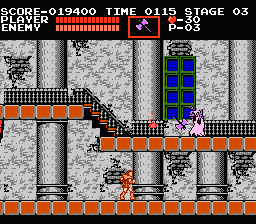
Even with Justin Bailey’s help, I suck at this game. And I love it. Image via Metroid Database
And to this day, I cling to that answer. It sounds strange, to think of metroidvania games—that is, platformers in which players explore a dangerous world and find objects to unlock new locations, so named for the Metroid and Castlevania franchises that perhaps best embody the genre—as an example of human worth, as a place of joy without talent, but here we are. We live in strange times, after all.
I love playing metroidvania games. I especially love the Castlevania franchise, although I admit I’ve played relatively few of the games, and I have only ever beat one of them. I also enjoy the Metroid franchise, which I have played a greater percentage of, but again have never actually beat any of them. But I love them and get excited about them.
I know I suck at it. Jumping isn’t my strong suit in games, and jumping and fighting together is even worse for me, because fighting isn’t my strong suit either. The bosses in these games are notoriously hard, “Nintendo hard” even. But I delight in the simplicity of their structure, and I revel in their music, because for some reason these games usually have amazing soundtracks. So I play them. A fair bit, actually. Because they’re fun. Because I just like being in that space. I have no expectation that I’ll ever be good at these games, or even see the end except vicariously. But that’s not a reason not to play them.
I know I suck at this game, but I just love that soundtrack so much (even if Simon can’t figure out how to jump off the stairs) Image via Castlevania Wiki
Nor is it any reason anyone should prevent me from playing them. For the people who are good at these games, who make let’s plays, who do speedruns, who just enjoy the games because they live and breathe them (like my brother), my hamfisted enjoyment of the games does no harm. In fact, it benefits them; I will watch their let’s plays, I will be in awe of their speedruns, I will seek their experience and wisdom on the topic. I will participate alongside them and be their support base and honor their talent and skill, precisely because I know I don’t have the same talent and skill, even if I can share in their joy.
In our current time, we’re constantly told to turn every interest into a “side hustle,” to convert interest into capital, to make everything an economic matter. But that leaves little room for our souls to breathe. We need more spaces where we can just enjoy, where we can have joy without talent, worth without economic value.
So, what’s something you enjoy but aren’t good at?
This week I had a very depressing thought: As a fully qualified person with a Ph.D., I am teaching essentially the same courses that I was teaching my first year of graduate school, with only a B.A. to my name and a week of “boot camp” training. Sure, I get paid more, but I also have four sections instead of two now.
While my inclination is to label myself a failure for not doing something “more interesting” (mental health has not been great lately), more careful and rational thought has me wondering if what we have here is actually a problem in higher education in which we dismiss the value of first year composition courses. These are courses that most institutions foist off on their lowest level instructors, often graduate students. While my current department admirably has graduate students work with an experienced faculty member as well as take a pedagogy course for a full semester before turning them loose in the classroom, that’s the exception, not the rule.
And this is, for many students, their first college class ever. The first semester is very important for retention and ultimate student success, because that’s the chance to help students find their place on campus. It’s where students learn the vital literacy of how to “do college” and “be college students,” which, for many students, is a very steep learning curve. At some level having the graduate students and lower-ranked faculty teach the courses makes sense, because these are the people closest in experience to the students, but at another you would want the best pedagogy you can get in these classrooms because these are such vital courses to student success.
However, we would be remiss to assume that senior faculty make better teachers, too. A dirty little secret of higher education, which my students are appalled by when they find out, is that the only qualification you actually need to become a college professor is the Ph.D., which requires no pedagogical training. The pedagogy side of higher education, for many disciplines, is more of a folk training, a network of hedge mages trading lessons from experience, instead of any formal study that benefits from the extensive research that exists on learning and teaching. In fact, that was one of the ways I was recruited into higher education: my adviser, when I was an undergraduate, encouraged me to leave the pre-education track in the English major, saying “I need a master’s degree in education to teach K-12, but I only need graduate degrees in my own field to teach college.” And I admit, reader, I was persuaded. Fortunately, I wound up going into Rhetoric and Composition, which disabused me of my pedagogical naivete.
Rhetoric and Composition, as a field, is something of an exception; my graduate work was probably at least a third pedagogy-related courses. It is a field that is obsessed with teaching itself; it is as much concerned with how do we teach writing as it is with how does writing work. This makes first year composition courses the locus of a wide range of pedagogical skill and theory—ranging from the entirely unqualified and terrified graduate student to the extremely experienced and well-researched expert in the field.
But the overall effect of only some fields requiring pedagogical training for faculty is that pedagogy often becomes an afterthought, and sometimes even a subject of derision. This is how we get a culture that focuses on content and testing rather than on the messier, more effective work of active learning.
So while at some level I feel like maybe there’s a personal failure in my career (my problem) because I’m still teaching first-year courses, it seems more likely that there’s a systemic failure because more professors are not teaching basic first-year courses, and they aren’t thinking carefully about pedagogy because they’re about as trained as my own first-year-of-graduate-school past self was. Let the graduate students teach the upperclassmen who know how to college; let’s give the freshmen our best teachers, though, because the freshmen need good pedagogy the most.
I don’t have a lot to say this week, but this came up recently in my Facebook memories. Last week I mentioned that I can’t remember ever not wanting to die. I honestly don’t think that’s a terrible thing. We all need to come to terms with morality somehow. So I give you this:
A cemetery in New Orleans. Photo by the author.
When I die, do not mourn me because I am gone; wherever I am gone, I am content to know that it exists. For: If there is heaven, then there is grace. If hell, justice. If another life, redemption. If purgatory, hope. If nothing at all, peace. When I die, do not mourn because I am gone. Mourn because you are not with me.
Last week, I introduced my students to the genre of the literature review. This is, for most first year composition students, an entirely alien genre, since it’s largely the province of academic work. However, the course I’m teaching requires, as part of its description, that my students produce an annotated bibliography of 15-20 sources and a research paper with original research of 8-12 pages. In essence, my students are being asked, often in their first year of college, to produce a graduate level conference paper. This is a tall order, but they can do it, with some good scaffolding. Obviously. I mean, they do it every semester.
One of the challenges in such a course is teaching students to write in a (sub?)genre that they may have never read before. Obviously, one solution is to have them read widely in that genre—which they will do—but even before they can do that, it’s necessary to know how to recognize what a literature review is.
Of course, I could highlight literature reviews in scholarly articles and show that to them. Of course, I can tell them what one is. But last week I had them do a literature review. I don’t mean write one. I mean to actually physically embody, by means of a classroom simulation, the purpose, function, and process of literature reviews.
This is a lesson plan that requires very little preparation on the instructor’s part, no homework on the students’ part, and no classroom technology, although it works best in classrooms with movable desks or other furniture that facilitates group work.
First, my students are accustomed to answering a “warm-up” question either as a freewrite or a small group discussion, which I write on the board at the beginning of class along with upcoming assignments and reminders, and the goals for the day. Thus, they were already primed to expect me to start with a question, and they already have a small group that they’re used to working with made up of the people around them. These are helpful, but not necessary for this activity to work.
So, I started by having them discuss a question in their usual small groups. You may use any debatable question. Because I like living dangerously, the question I asked was “What value, if any, is there in having writing courses in the core curriculum?” At least I knew it was relevant to everyone in the room.
I gave them a few minutes to discuss the question. Then I instructed them to select a delegate from their group. The delegate then went to another group. There, the discussion was to continue, but first the group had to fill in the delegate on what had already been said in that group, but also the delegate had to explain what was said in their original group.
Then, I repeated this process, stipulating that the second delegate could not be the same person. That way, the group kept the new person and sent on an older member. Again, the groups were to catch the new person up and listen to what the new person knew from the other groups.
Now I brought the class back together. Here, I explained what the meaning of the activity was: they had “cross-pollinated” knowledge across the classroom. What we had done is turned the classroom into a simulation of the entire academic field, or perhaps a given discipline. Each person belongs to some smaller group they interact with regularly—their department, their friends from grad school, their lab group, etc—and they constantly exchange ideas with these people. Then sometimes ideas are spread through the community by sending members of these smaller cells to visit other cells—this represents things like conferences, guest lectures, hiring new people from other institutions, and publishing in journals.
But every time ideas are exchanged, some amount of background material has to go with them. After all, we don’t know that the people we’re talking to know all the necessary background that provides the definitions, practices, and source material for what we’re saying, so we have to fill them in on that.
And that, I argued to my students, is the purpose of the literature review.
And then we discussed the form that their briefings took. I noted that they had used very common lit review techniques in filling each other in on the discussion, summarizing main ideas rather than devoting specific summary spaces to each individual speaker.
And then I gathered up the main ideas that they discussed, noting these on the board where I could manipulate them. From there, I modeled how to write a literature review in the academic style and tone, based on the notes we had. I synthesized what they said were the main points into something that sounded like it could fit in a scholarly paper. These were simple, more suited to be the opening moves of a literature review than the whole thing, but they definitely have the style. Here is what we wrote out:
There is general agreement that writing skills are important life skills. Some students, however, have expressed concern that college writing courses may be redundant with high school requirements. Others have argued that writing is discipline-specific and therefore may be better taught within major programs
My 1st class (note that I forgot to tag on an identification of a “gap” with this class–it’s 8am, ok?
Most students generally agree that writing courses are useful in the core curriculum because these courses help develop effective communication skills. However, some students have expressed concerns that these courses may not be as relevant to some majors. I would argue that these views, while important, neglect the listening and reading skills afforded by writing courses
2nd class, 9am
In general, students agree that writing and research are useful skills. However, there is some debate about the necessity of required core courses dedicated to writing and research because many students note that these courses often repeat prior content, though they may also deepen it. Yet, what is required is an examination of some of this overlap and to identify ways to distinguish course content from other core courses.
3rd class, 1pm
Generally, students see utility in writing courses being included in core curriculum requirements because they understand that writing and research are transferrable skills for their careers and other courses. However, many students express concerns about repetition between courses as well as the relevance of specific course content.
Therefore, more research needs to be done on where points of overlap exist and how the ensure each course offers unique, transferable skills.
4th class, 3pm
Notice that each of these, although similar, is definitely distinct. The key here is to work with what the students are saying and not deviate from it. This models, in part, that the literature review is an act of listening, by modeling listening to the students and valuing their voices as researchers, even though the data generated in the classroom here is very limited.
Then, I annotated what I synthesized out of what they were saying. I’m using the textbook They Say / I Say by Gerald Graff and Cathy Birkenstein, but my students haven’t really started reading it yet for the course (we have another handbook that they’re reading out of first). However, this was a place I could introduce Graff and Birkenstein’s main concept, so I walked them through marking the “they say” moves (what other people said, with reference to the author of our new paragraph) and the “I say” moves, showing them how the literature review is primarily “they say” moves followed by a section of “I say” moves to identify the “gap.”
I can’t express how much I love this book!
The next step is, of course, to identify literature reviews in published materials and get them reading the target genre. However, in 50 minutes, we started on that path, but were not able to get very far. That’s ok; we’ve got time to do that in later class meetings.
I don’t always have the best lesson plans, of course, but I think this one worked pretty well, because it was active (literally moving around the classroom) and mixed prior competencies with engaged activity, and it utilized the full range of doing, speaking, listening, reflecting, identifying, etc. all in one less-than-50-minute sequence.
So there it is, my gift to you. Feel free to use it.
When I was in 6th grade, I tried to kill myself. Well, more accurately (as far as I’m concerned), I tried an experiment to see if I could kill myself, but therapists tell me that’s the same thing. That same year, I had a friend who was starving herself. I also had a friend who would literally throw up from anxiety in crowds.
And, honestly, none of that sounds odd or unusual to me. It was all perfectly normal.
In later years I would have friends who cut themselves, friends who were closeted, friends who had experienced trauma, friends with any number of psychological disorders… And none of it seemed, or seems, strange or special to me. It all seems perfectly normal.
Thing is, when I tried to kill myself, that wasn’t a new thing. Like, the idea that I actually could do such a thing was new (inspired by a minor accident with a knife while cutting carrots), but I can’t remember ever not wanting to die—more as a curiosity I think than as a goal, but there it was. It was always there. And the few times in my life that voice has gone away have been much scarier than when it’s present.
No, what baffles me is the existence of supposedly “normal” or “neurotypical” people. I’m not sure I know any. As far as I can tell, the only difference between someone with mental illness and a “neurotypical” individual is a diagnosis. There’s a part of me that’s pretty darn sure neurotypical people don’t exist.
I never saw a therapist until I had nearly finished my master’s degree. It was, actually, the disappearance of the suicidal voice that made me realize I needed help, because without it the depression suddenly was unbearably hopeless, because without it I felt completely without agency.
For the past decade or so (I guess it would have been 2011 when I started therapy the first time?), I’ve bounced around from therapist to therapist, depending on access, insurance, location, etc. Some I’ve liked, some weren’t great matches for me, but that’s normal. It’s gotten to a point where I pretty much know, at least for someone presenting as I do, what their training says to do, and I can anticipate their moves like an expert chess player can read a board. It’s kind of like how I know most of the audiologist’s tricks because of sheer experience being a perennial patient (none of this eliminates the need for these professionals to do their jobs, nor could I do their jobs for them).
And if I were to describe the journey of therapy, I’d say it’s mostly a journey of learning that everything I thought was normal is… not? I guess? Sometimes that’s more distressing than the symptoms I walked in with, honestly.
I lived over a quarter century with undiagnosed mental illness. Most of my closest circle have similar symptoms. I had developed a complex and precise language for talking about and managing symptoms.
But mostly I’d figured that it was just what everyone experienced but just wasn’t talked about. You know, like how everyone farts but it’s not polite to talk about it? I figured everyone’s brains were constantly telling them they were worthless too. That’s just the human condition, right?
And I might be forgiven for thinking such. Raised in military culture, you absolutely didn’t talk about mental illness; even by mere association, that could end a man’s career (it’s gotten better in the past two decades or so). And literature abounds with meditations on suicide and feelings of worthlessness; it’s filled with anxious and depressed characters, or any other kind of mental illness. And that’s really what I was gauging “normal” by, since you can’t really see the inner thoughts of real people, but you can of literary characters.
Honestly, when therapists talk about goals of being “symptom free,” I get scared. I have no model of what “symptom free” looks like—is anyone actually symptom free? And I don’t know if it’s possible. At what point do we stop eliminating symptoms and start erasing the person? I don’t have an answer.
What I do know is that “normal” is a very strange category, and I’m not sure I’ve ever met a “normal” person. As far as I’m concerned, it’s normal to be strange.







 Dr. Cox's Desk